From Feed to Experience: Turning Google Traffic into High-Converting Product Pages

Author:
Ashley Peña
February 4, 2026
Modern advertising platforms like Google (including Shopping and Performance Max) and Meta have become increasingly automated. These systems now automate decisions about which products are shown to which users, on what platform, with which creative, and at what bid. But for many brands,this automation still routes traffic to a generic, one-size-fits-all product detail page. This disconnect between automated advertising and static landing pages can result in lost conversions and reduced profit margins.
In 2026, the most successful brands will be those that treat their product feed, Merchant Center, and landing pages not as separate components, but as a single, integrated system. This "feed-to-experience" approach transforms catalog-scale automation into a driver of profitable growth, ensuring that every click leads to a tailored and effective customer experience.
“Some leading retailers like Wayfair, Target, and Anthropologie have pioneered what they call "interstitial PDPs", intermediate landing pages that sit between the ad click and the traditional product page, designed to match the specific intent of the traffic source. This is the model that FERMÀT’s dynamic product pages bring to scale for any catalog.” – Rishabh Jain
Google's algorithms are constantly learning from your product feed and your website. They use this information to decide what to show and where to send users.
In every case, your feed and your pages are working together. The feed tells Google what you sell, and your pages tell Google how relevant that product is for a specific user.
PMAX's "black box" nature makes this even more challenging. Brands can't always control where traffic lands, making it even more important that the destination URL leads to a flexible, adaptive experience.
If your product pages are sparse, generic, or disconnected from the search query that brought the user there, you're limiting the effectiveness of Google's AI. But if your pages are rich with information, tailored to user intent, and structured around the shopper's needs, you're giving the system better options, and that's usually rewarded over time.
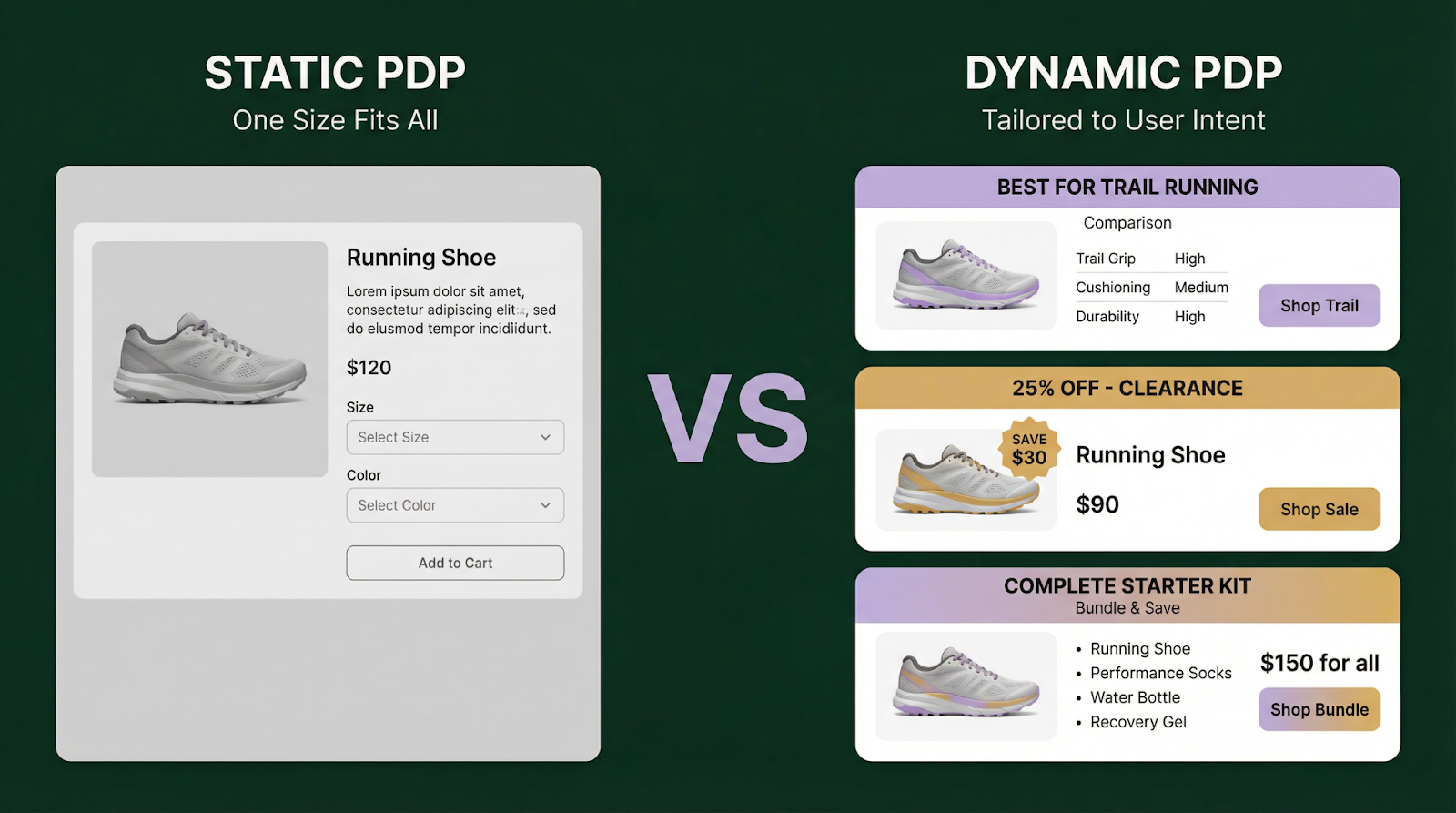
Most e-commerce sites still rely on static PDPs. The layout, content, and merchandising are the same for everyone, whether they searched for "best trail running shoes under $150" or clicked on a branded term.
Static PDPs are often ineffective because they:
The window of opportunity is narrow. If the landing page doesn't immediately match the user's intent, they'll click back to Google and likely buy from a competitor. Dynamic pages are designed to capture that customer in the critical first few seconds
Instead of a rigid, hard-coded template, dynamic pages offer a versatile canvas where you can adapt the layout, content, and merchandising based on:
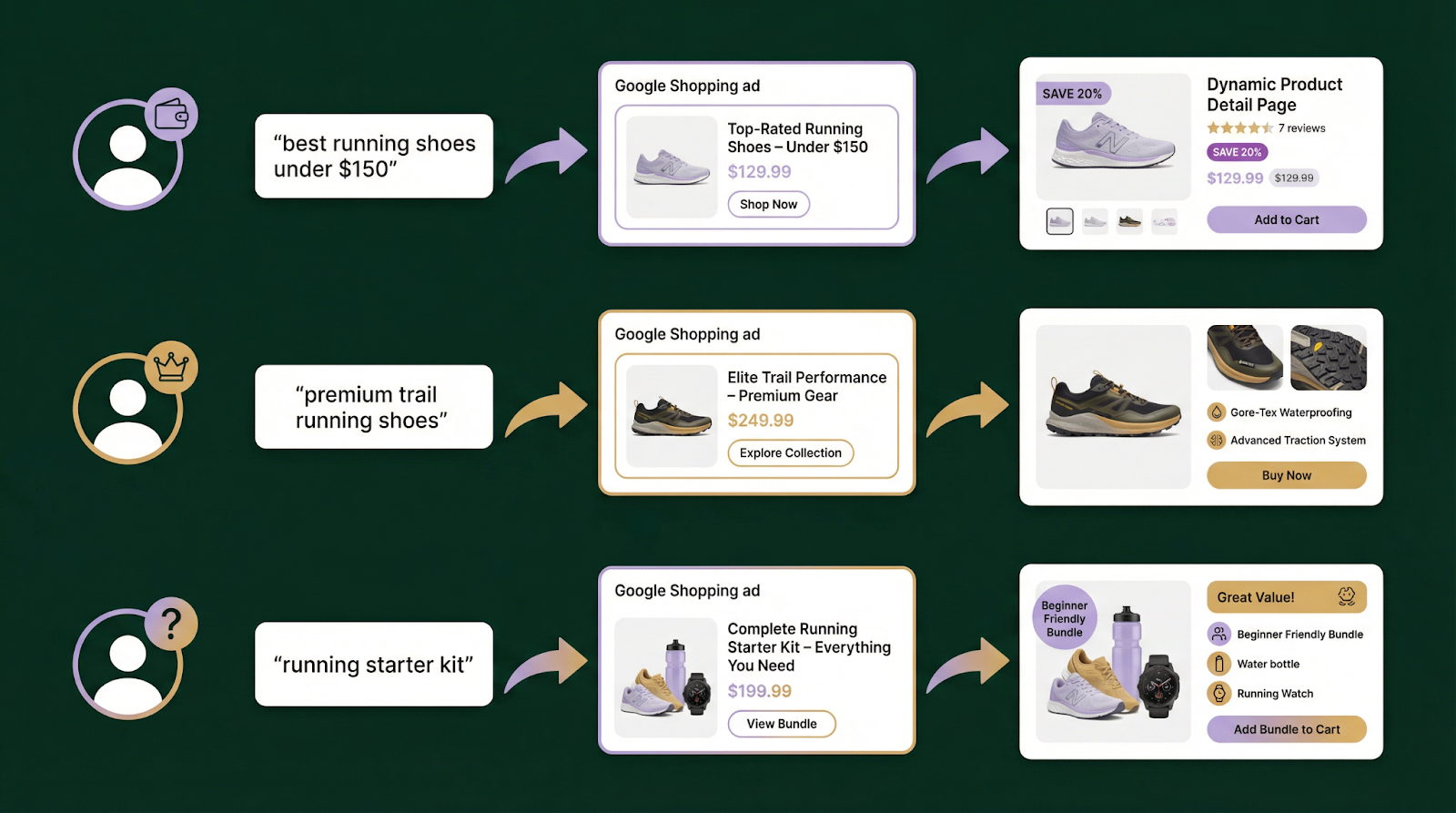
With a dynamic page, the same product can be presented in different ways to meet the shopper's needs at that moment. For example:
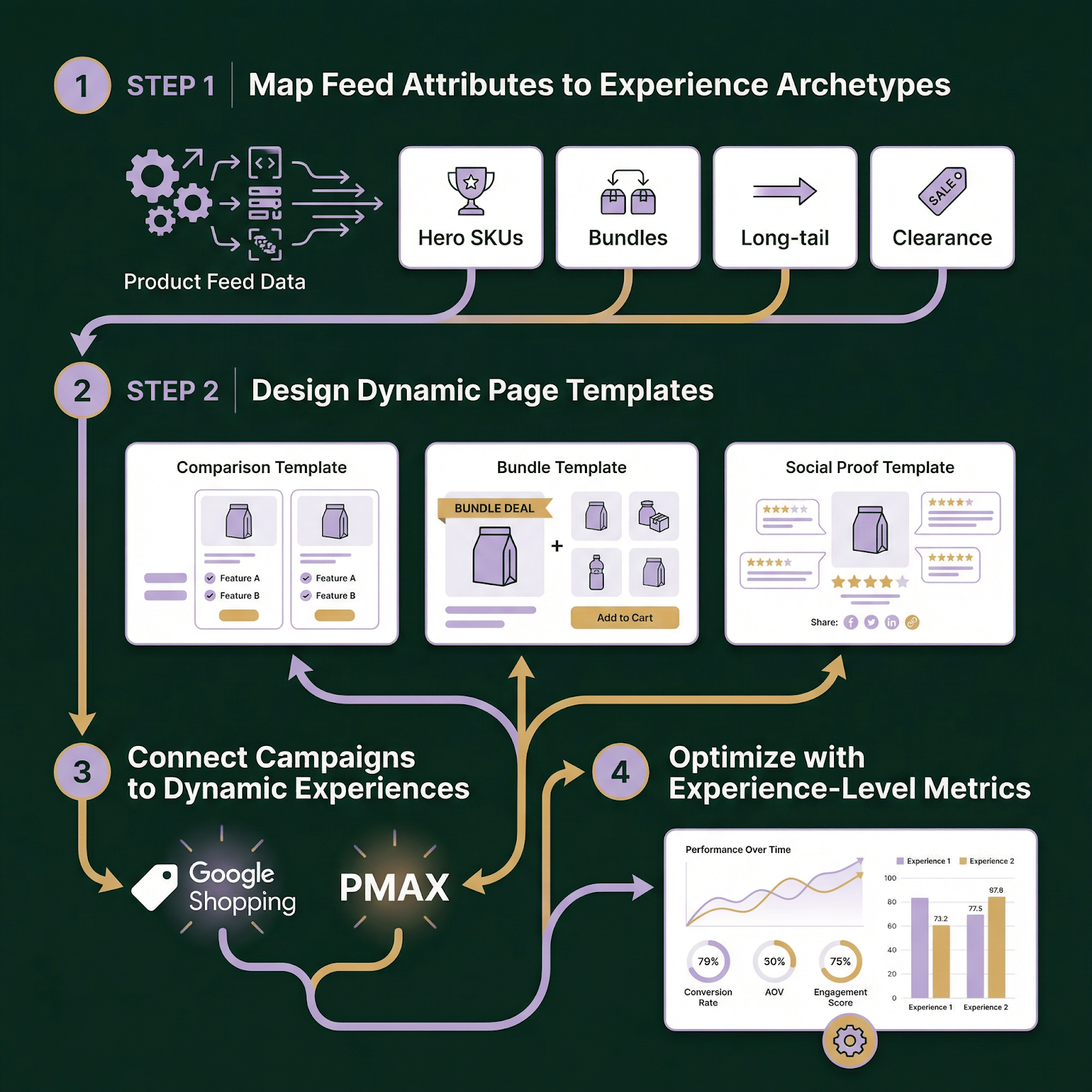
Implementing a dynamic system requires more than just a few A/B tests. It requires a shared architecture that connects your feed, page templates, and campaigns.
Your product feed is already rich with signals that can be leveraged to create a more effective experience.
From this data, you can define a set of "experience archetypes," such as:
Each archetype can then be mapped to a different landing experience, like a single-SKU dynamic page, a bundle page, or even a shoppable article.
Next, create three to five reusable dynamic templates that can be customized at scale. For instance:
Each template should be designed to make the essential information easy for Google to parse and for users to act on, with clean titles, clear pricing, and prominent calls-to-action.
With your archetypes and templates in place, the next step is to route traffic effectively.
The goal is simple: when Google finds the right user and the right product, the destination page should feel like it was designed specifically for them.
Once your system is live, optimization becomes a matter of creating and monitoring feedback loops. Instead of focusing only on Return on Ad Spend (ROAS), you should also analyze:
With a robust experimentation layer, you can continuously test and refine your approach, making durable improvements that will compound over time.
Most tools on the market either help you manage your feed or tweak your on-site layouts. Very few are built to bridge the gap and treat the feed, campaigns, and landing experiences as a single, interconnected loop.
FERMÀT is designed specifically for this middle layer. It connects to your e-commerce platform, product catalog, and ad platforms, ensuring your dynamic pages are always in sync with live pricing, inventory, and performance data. It automatically generates dynamic pages tailored to the user's entry point, using your brand's guidelines and real campaign context.
In practice, this means your Merchant Center feed and Google campaigns no longer point to a static template but to a living, learning conversion layer.
Many teams still view their product catalog as a massive spreadsheet: thousands of SKUs, each with a corresponding row, bid, and generic PDP URL.
The opportunity in 2026 is to reframe that spreadsheet as a collection of experiences. Every row in your feed represents a potential customer journey: a specific user with a specific intent, seeing a specific product, and landing on a page that feels personally designed for them.
When you architect your system from feed to experience, Google’s automation does more than just drive traffic, it drives the right traffic to the right dynamic product experiences. This is how you can simultaneously improve acquisition efficiency, AOV, and profit margins.
If you are ready to see what this approach could look like for your own catalog, the fastest way to begin is simple: route a portion of your Shopping or PMAX traffic to dynamic product pages, test it head-to-head against your current PDPs, and measure the lift.
