Your Customer Data is Unified. So Why Are Your On-Site Experiences Still Generic?

Author:
Ashley Peña
February 24, 2026
You’ve spent millions to connect your customer data. Your CRM, analytics, and marketing platforms are finally talking to one another, creating a single, coherent view of your customer. You know their history, their behaviors, and their intent. You use this intelligence to craft hyper-targeted ad campaigns that bring high-value accounts directly to your digital doorstep. And then, you show them the exact same generic product page as everyone else.
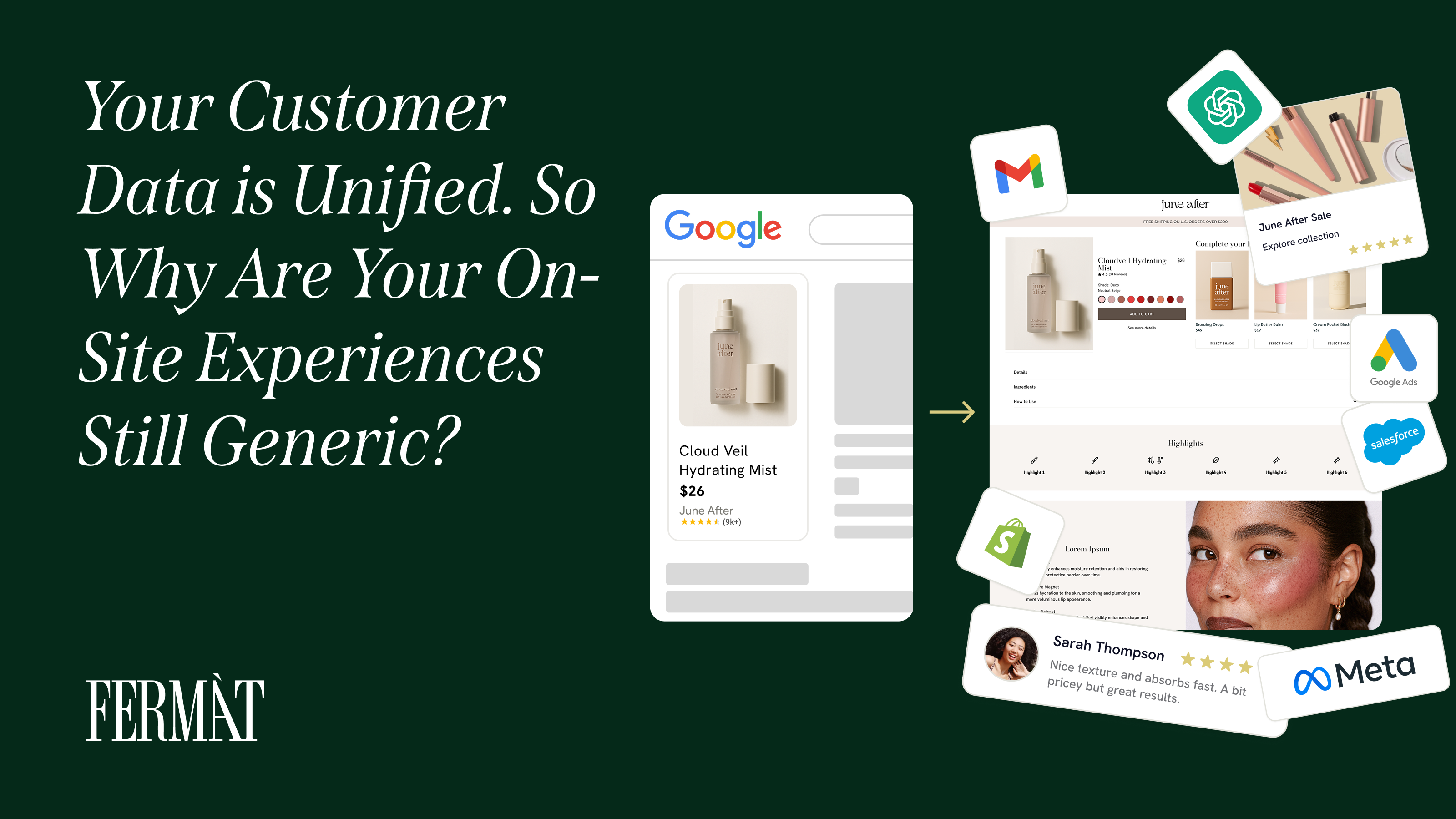
This is the great disconnect in modern B2B commerce. The final, most critical inch of the customer journey, the on-site experience, is where the value of unified data often goes to die. While organizations have made massive strides in data integration, many still treat their websites as static destinations rather than dynamic, responsive engines for conversion. The result is a jarring gap between the personalized promise of the ad and the one-size-fits-all reality of the landing page.
The drive to unify customer data has become a strategic priority for B2B organizations. As the digital landscape shifts away from third-party cookies, first-party data has been correctly identified as an essential strategic asset. Recent 2026 research shows that while 91% of B2B marketers are actively collecting first-party data, a significant maturity gap exists. Only about half have established advanced strategies, leaving the rest in the early stages of development.
This push has led to the rise of "omnichannel customer hubs", integrated systems designed to provide consistent context across every touchpoint, from web chats to sales calls. The goal is to create a seamless experience where the customer never has to repeat themselves and the organization always has full context. Yet, even with this unified backend, the frontend experience often remains stubbornly generic.
"The biggest disconnect in e-commerce today is between the hyper-targeted ad and the one-size-fits-all landing page," notes Shreyas Kumar, co-founder of FERMÀT. "We see brilliant marketers get customers 99% of the way there, but the final 1%, the actual on-site experience, is where the conversion is lost."
This isn’t just a missed opportunity; it’s a significant waste of resources. When a highly-qualified account, nurtured through a personalized ad campaign, lands on a generic page that doesn’t reflect their specific needs or context, the intelligence that brought them there is nullified. The conversation becomes one-sided, and the momentum is lost.
Three converging trends make solving this on-site experience gap a critical imperative for growth.
First, AI-powered hyper-personalization is now a baseline expectation, not a differentiator. Customers, conditioned by consumer-grade experiences, expect companies to recognize their history and tailor the journey accordingly. This pressure is driving investment in personalization, with recent studies showing 26% of retail executives are already implementing personalized AI recommendations and another 35% plan to do so within the next year.
Second, the most forward-thinking B2B organizations are breaking down internal silos to form unified revenue teams with shared KPIs and accountability. This shift from measuring lead volume to measuring pipeline quality and revenue contribution means that marketing is now directly responsible for the effectiveness of the entire funnel, including the on-site conversion.
Third, the focus has shifted from growth-at-any-cost to efficient, data-driven growth. Every dollar of marketing spend is under scrutiny, and the ability to connect investment to revenue impact is paramount. Wasting high-intent traffic on generic landing pages is an inefficiency that growth-focused companies can no longer afford.
The solution is not to stop connecting data. The solution is to extend that unified intelligence to the final, most crucial touchpoint: the on-site experience. It’s time to move beyond a static website and embrace a model of dynamic, feed-driven experiences where the content of the page is as personalized as the ad that led to it.
Building this capability requires a shift in thinking:
For years, B2B organizations have focused on building a complete memory of their customers. The strategic imperative for 2026 and beyond is to use that memory to have a more intelligent conversation. A Total Experience Profile is only as valuable as the experience it powers.
When your on-site experience is as dynamic and data-driven as your customer acquisition strategy, the disconnect vanishes. The journey becomes a single, coherent conversation that starts with the ad and culminates in a conversion. The organizations that master this will not only see better returns on their marketing spend; they will build deeper, more resilient relationships with their customers, who finally feel seen and understood at every step of their journey.
FERMÀT enables brands to close the gap between unified customer data and dynamic on-site experiences by empowering marketers to create, test, and optimize SKU-level product funnels without developer dependencies. Instead of sending all your traffic to the same static product page, FERMÀT lets you build feed-driven, personalized experiences that adapt to who's visiting, turning your unified customer intelligence into actual conversion lift.
The platform supports experimentation velocity at scale, allowing teams to run A/B tests on individual product experiences, iterate based on real-time data, and activate the insights from your unified customer profiles where they matter most: at the moment of conversion. Whether you're personalizing landing pages based on ad source, tailoring product narratives for different buyer segments, or testing new approaches to social proof, FERMÀT gives marketers the tools to act on their data without waiting for development cycles.
The result is a world where your on-site experience is as intelligent as your targeting strategy, where the conversation that begins with a personalized ad continues seamlessly through to a personalized product experience. That's the future of efficient growth.
