Your Competitors Are Measuring the Wrong Thing in AI Search

Author:
Ashley Peña
March 11, 2026
Every brand tracking AI search right now is watching a visibility score. It feels like progress. It looks like a dashboard. But, it tells you almost nothing about whether you're winning.
Visibility scores are the follower counts of AI search, vanity metrics dressed up as strategy. The brands pulling ahead aren't the ones with the highest score on any given Tuesday. They're the ones whose citations are compounding week over week, building an authority flywheel that gets harder to displace over time.
That gap, between a snapshot and a trajectory, is the most important thing a commerce brand can understand about AI search right now.
The problem isn't that visibility scores are useless. It's that they're inconsistent by design.
AI platforms like ChatGPT and Perplexity don't return the same answers twice. One tool measures brand mentions. Another measures citation frequency. A third tracks share of voice across a curated prompt set. They rarely agree, and they can all be gamed.
As FERMÀT’s Engineering Lead, Josh Feiber, put it: "Overall visibility [is like] snake oil. You can make it whatever you want it to be. Some providers inflate scores by running cherry-picked prompt sets or weighting branded queries alongside genuinely competitive ones. Without a standardized methodology, every vendor's score tells a different story."
Visibility scores measure presence. They don't measure momentum. And momentum is what actually wins.
The data from brands actively publishing content for AI agents to consume using FERMÀT tells a different story.One brand went from single-digit citations to nearly 300 in a matter of weeks, not a linear climb, but a compounding curve driven by consistent publishing. Another crossed 50 citations in its first active week, then surpassed 500 platform-wide weekly citations by early March 2026.
One brand tracked through FERMÀT's AI-ready content architecture logged 3,300+ AI agent visits in 30 days. Another saw ChatGPT-attributed traffic jump 150% in a single month.
The broader trend backs this up. According to Adobe Digital Insights, AI referral traffic to U.S. retail sites grew 4,700% year-over-year, with AI-referred visitors showing lower bounce rates and longer sessions than organic search visitors. The channel is not experimental. It's accelerating.
LLMs operate on trust signals that reinforce themselves over time. Content updated recently gets cited far more often than older material. Once a brand earns initial citations, subsequent content from the same domain gets crawled faster and cited more readily, the model has already established trust with the source.
Through FERMÀT's AI-ready content architecture and third-party research, here's what we've found actually moves the needle:
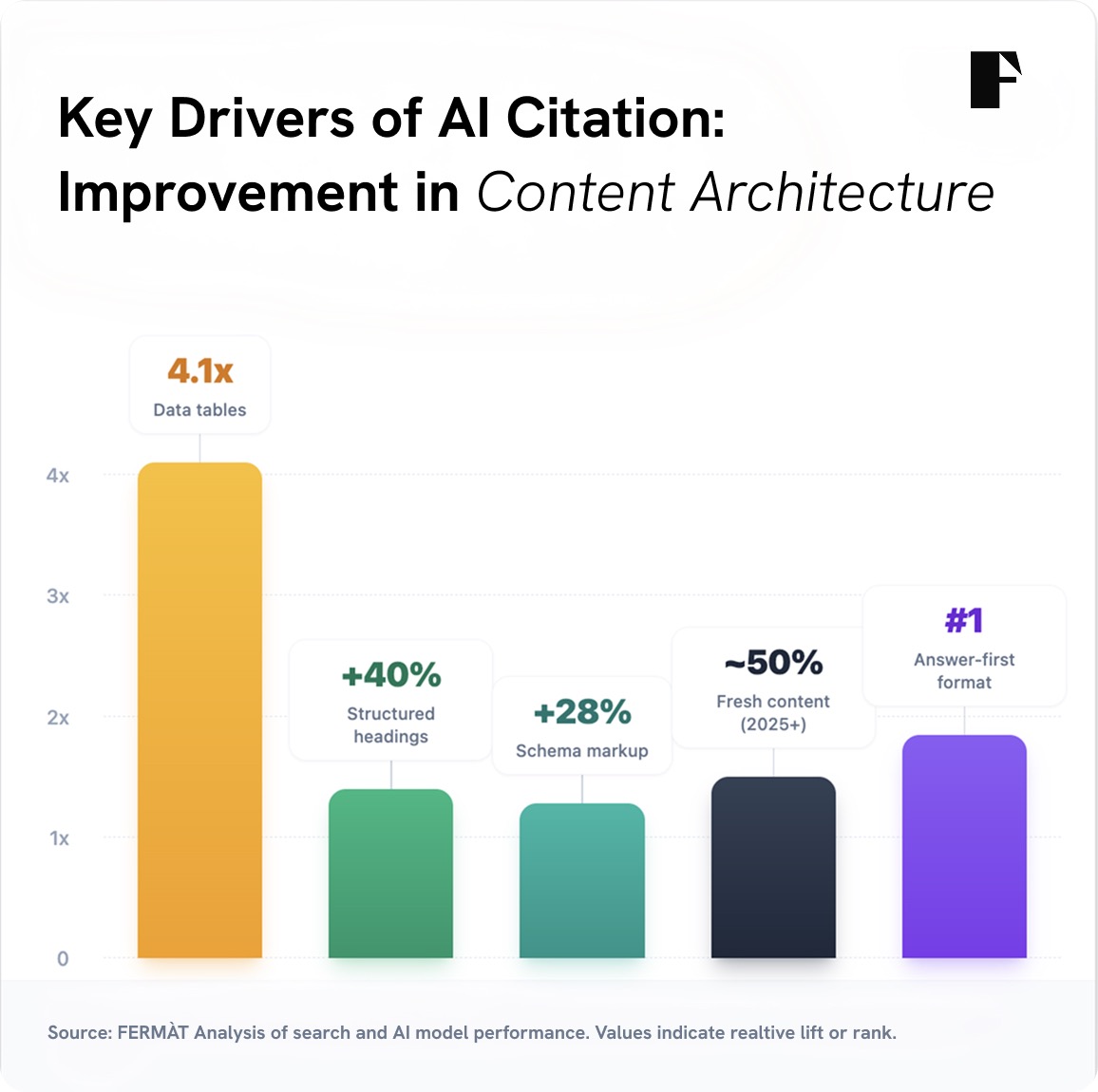
These aren't SEO tricks. They're the signals that tell LLMs a piece of content is worth surfacing.
The brands winning in AI search aren't asking "what's our visibility score?" They're tracking three things:
That last number is worth sitting with. AI-referred visitors have already had a conversation, received a recommendation, and arrived with high intent. The citation didn't just generate awareness, it pre-qualified the customer.
Consistent citation velocity requires consistent, well-structured content output. That requires infrastructure, not just effort.
FERMÀT's AI-ready content architecture embeds the structural signals, schema, freshness, answer-formatted content, merchant product feeds, directly into the commerce experience. The result is content that compounds in AI search, earning citations that drive agentic checkout and contextual commerce interactions.
"The brands pulling ahead in AI search aren't publishing more," says Rishabh Jain, CEO of FERMÀT. "They're publishing smarter, with the architecture to make every piece of content a citation candidate from the moment it goes live."
AI search for commerce isn't a content marketing problem. The brands pulling ahead aren't publishing more, they're publishing with the architecture to make every piece of content a citation candidate from day one.
Most boardrooms are still asking "are we visible?" That's the wrong question.
The right one: how fast are your citations growing, and what's driving the acceleration?
Brands that answer it, with data, with architecture, and with a publishing cadence built for LLM trust, aren't just winning AI search. They're building a moat that gets deeper every week.
